

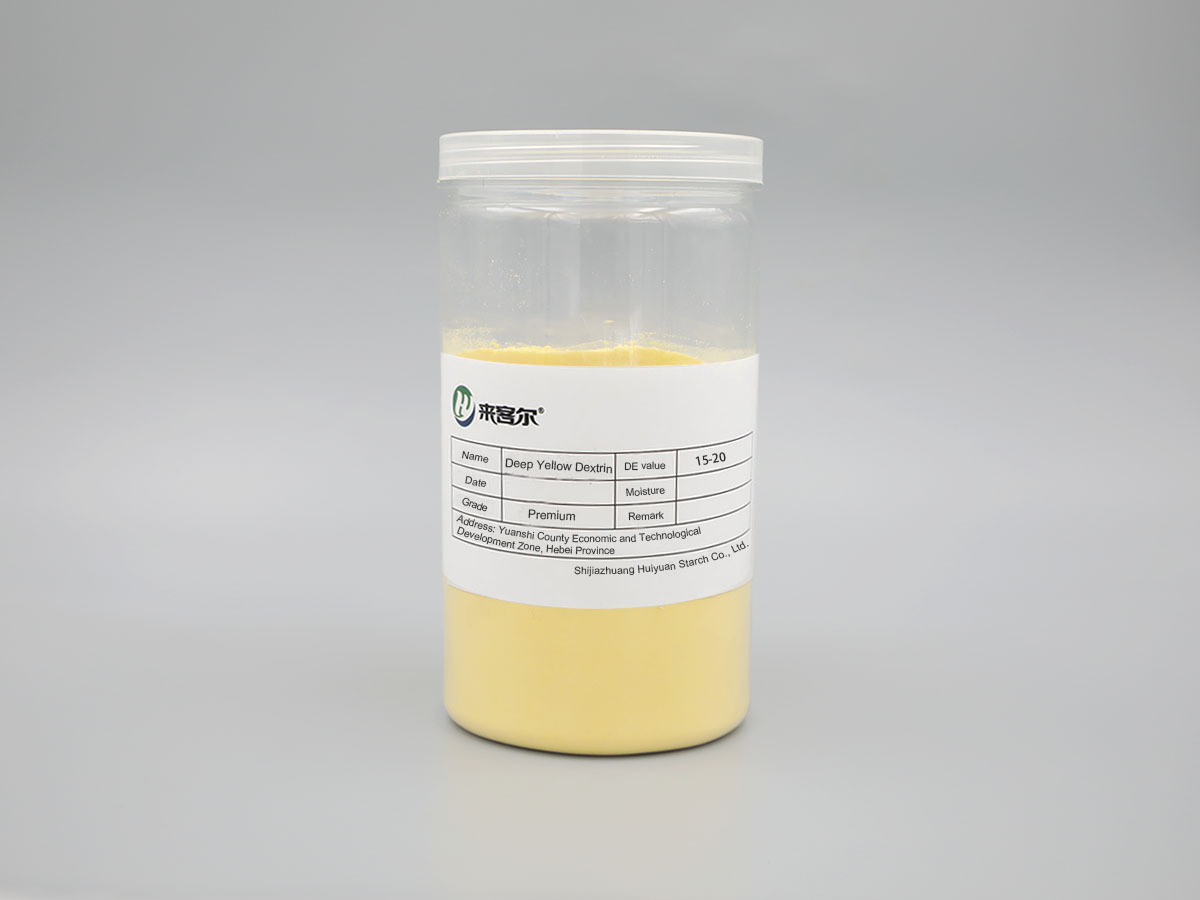


Deep Yellow Dextrin
KeyWord:
Classification:
Detail
I. Product overview
Maltodextrin (MD) is a powder product made with starch as the raw material through purification after liquidation of amylase, concentration and spray drying. It is a starch derivative that does not contain free starch. Maltodextrin characterized by high viscosity, strong enhancement, good solubility, instant dissolution, good carrier property, little fermentation, low moisture adsorption, no unpleasant odor, low sweetness, good digestive absorption, low calorie and low fat is one of the most ideal basic raw materials in the food industry and has been applied in an increasing number of fields, such as papermaking, daily chemical, fine chemical, pharmaceutical industry, etc.
II. Process flow
Starch milk→syrup preparation→liquidation→high-temperature enzyme deactivation→slag removal filtration→decolorizing filtration→ion exchange→decolorizing filtration→vacuum multi-effect falling film concentration→spray drying→ packing and warehousing.
III. Product indexes
Sensory requirements
|
Items |
Requirements |
|
|
Solid |
Liquid |
|
|
State |
Slightly hygroscopic powder or particles without sundries that can be seen with normal eyesight |
Viscous liquid without sundries that can be seen with normal eyesigh |
|
Color and luster |
White or slightly yellow |
Colorless or slightly yellow |
|
Smell |
With the unique smell of maltodextrin |
|
|
Taste |
Not sweet or slight sweet, without unpleasant odor |
|
Physical and chemical requirements
|
Items |
Requirements |
|||||
|
MD10 |
MD15 |
MD20 |
||||
|
Solid |
Liquid |
Solid |
Liquid |
Solid |
Liquid |
|
|
DE value (calculated on the dry basis) % |
DE≤10 |
10<DE value≤15 |
15<DE value<20 |
|||
|
Water content /(g/100g) ≤ |
6.0 |
- |
6.0 |
- |
6.0 |
- |
|
Dry substance (solid) % ≥ |
- |
50 |
- |
50 |
- |
50 |
|
pH |
4.0~7.0 |
|||||
|
Solubility ≥ |
98.0 |
- |
98.0 |
- |
98.0 |
- |
|
Sulphated ash ≤ |
0.5 |
|||||
IV. Product features
● The main properties of maltodextrin are directly related to the degree of hydrolysis (DE). Therefore, the DE value not only represents the degree of hydrolysis, but also serves as an important index indicating the product properties.
●When the DE value of maltodextrin is 4%-6%, its sugar groups are large molecules above tetrose.
●When the DE value of maltodextrin is 9%-12%, its carbohydrates are mainly high-molecule carbohydrates, and the proportion of low-molecule carbohydrates is relatively low. Therefore, this product is not sweet, and not easy to get damp or brown. By using it in foods, the sense of touch of goods can be improved, and the viscosity will get higher.
●When the DE value of maltodextrin is 13%-17%, its sweetness is relatively low, it is not easy to get damp, and contains a low content of reducing sugars, so it is hard to brown and has good solubility. By using this product in foods, the viscosity of foods will be improved. When the DE value of maltodextrin is 18%-22%, it is a little sweet, can get damp to some extent, contains a proper proportion of reducing sugars, can brown and has good solubility. When using it in foods, the viscosity of foods will not be improved.
Maltodextrin that conforms to national standards mainly has the following characteristics:
(1) Good fluidity, no unpleasant odor of starch.
(2) It is barely sweet.
(3) It has good solubility and appropriate viscosity.
(4) It is not easy to get damp or cake.
(5) It can resist high temperature and will not brown.
(6) It will not cover other original flavor or fragrance even much of this product is used.
(7) It can serve as a good carrier of various sweetening agents, flavoring agents and fillers.
(8) It can achieve good emulsification and thickening effects.
(9) It can promote product shaping and inhibit the product structure effectively.
(10) With the good film forming performance, it can prevent product deformation and improve the product appearance.
(11) It is easy to absorb, so it is very suitable for being the basic raw material of foods for patients as well as infants and toddlers.
(12) It can stabilize foams of foods and beverages very well.
(13) It can resist acid and salt very well.
(14) It can inhibit crystallization of crystalline sugars and can significantly resist grit and melting.
V. Application industries:
Maltodextrin is mainly applied in food, pharmaceutical, construction, papermaking, chemical, etc.
1. Applicable foods mainly include: candies, beverages, instant foods, canned foods, dairy products, bean products, baked and dehydrated vegetables.
(1) In the candy industry, maltodextrin is mainly used as a raw material to enhance the tenacity of candies, resist grit and melting of candies, particularly can reduce the sweet the candies, improve the taste, improve the tissue structure and significantly prolong the shelf life of candies.
Application of maltodextrin in candies
|
Name |
Dosage/% |
Function |
|
Bonbon |
20-30 |
Resist grit and melting, reduce decayed teeth and other diseases |
|
Jelly drops |
20-40 |
Resist grit and melting, reduce decayed teeth and other diseases |
|
Sticky candies |
20-40 |
Enhance the elasticity and toughness and improve the flavor |
|
Xiaogan Sesame Candy |
20-30 |
Prevent dampness, and reduce or remove stickiness |
|
Jiangsu-style candies |
15-20 |
Prevent dampness, reduce the sweetness and improve the flavor |
|
Chocolates |
10-15 |
Save milk fat, improve the flavor, improve the quality and reduce the cost |
(2) In the beverage industry
Maltodextrin is used as a basic raw material. By combining with reasonable blending, the original natural flavor will be realized, nutritive losses will be lowered, the solubility, the viscosity and the taste will be improved, the sweetness will be reduced and the economic benefit will be increased. Traditional ice cream is made of milk, egg and starch, so the cost is high and there is an obvious egg and starch smell. In contrast, the ice cream made with maltodextrin as the auxiliary material is rich in nutrition and types, easy to absorb, does not contain cholesterol and has a natural and delicate taste. So, it is a top-grade cooler. Solid liquors, instant tea and instant coffee products made with maltodextrin as the carrier can reserve the taste, have a good flavor, high solubility and viscosity and a low cost.
① In the solid beverage industry, it is used in milky tea, fruit crystal, instant tea and solid team to reserve the original feature and flavor of products, reduce the cost, make the taste mellow, delicate and strong, achieve high solubility and resist crystallization and precipitation. It can also achieve a good emulsification effect and serve as a good carrier. The reference dosage is 10%-30%. The dosage of maltodextrin (DE value: 24-29) used for producing coffee mate can be up to 70%.
② It can be used in juice drinks, such as coconut milk team, peanut almond juice and kinds of lactic acid drinks. It is of a strong emulsification effect, can reserve the original nutritional flavor of fruit juice, is easy to absorb, highly viscous, pure, stable and not easy to percipitate. Maltodextrin can be used in sports drinks. In metabolism, it can keep balanced calorie consumption in human body and reduce the digestion and absorption load in intestines and stomach. The reference dosage is 5%-15%.
③ Maltodextrin can be used in ice cream, ice pop, ice-lolly and other frozen foods to realize expanded and delicate ice grains, good viscosity, moderate sweetness, little or no cholesterol, pure flavor, good taste, etc. The dosage can be 10%-25%.
Application of maltodextrin in beverages
|
Name |
Dosage % |
Function |
|
Coolers |
5-15 |
Increase the viscosity, improve the flavor and taste |
|
Solid drinks |
10-30 |
Reduce nutritional losses, improve the solubility and quality, as well as the flavor and viscosity |
|
Coffee drinks |
5-15 |
Serve as filler, reduce the cost, improve the flavor and lower the content of coffeine |
|
Instant milk powder |
15-25 |
Improve the flavor and reduce the cost |
|
Ice cream powder |
10-25 |
Improve the tissue structure, the emulsification effect and the flavor and reduce the cost |
|
Baby milk powder |
5-20 |
Improve the nutrition proportion and the nutritional value |
|
Yolk powder |
5-10 |
Improve the nutrition proportion and the nutritional value |
|
Enzyme preparation |
5-10 |
Serve as a carrier and reduce the activity loss of enzyme |
(3) In instant foods
Maltodextrin can be used in ingredients of instant foods to significantly improve the flavor, increase the number of varieties, reduce the cost and improve the economic benefit. Currently, the output of foods for children in China is not high, mainly because there is no ideal “carrier”, and products are not easy to digest, and cannot meet children's actual demands or promote healthy development of children.
Application of maltodextrin in instant foods
|
Name |
Dosage % |
Function |
|
Health care products |
5-15 |
Reduce nutritional losses, improve the taste and improve the health care effect |
|
Fortified food |
15-30 |
Reduce nutritional losses, improve the taste and improve the health care effect |
|
Baby foods |
5-10 |
Reduce nutritional losses, improve the taste and improve the health care effect |
|
Instant foods |
5-15 |
Increase the viscosity, improve the structure and the intuitive effect of consumption |
|
Soups and juices |
5-10 |
Increase the viscosity, improve the structure and the intuitive effect of consumption |
|
Western foods |
5-10 |
Increase the viscosity, improve the structure and the intuitive effect of consumption |
(4) Application in canned foods
|
Name |
Dosage % |
Function |
|
Various cans |
5-10 |
Increase the viscosity and improve the flavor |
|
Jelly |
5-10 |
Increase the viscosity and improve the flavor |
|
Fruit tea |
10-20 |
Increase the viscosity and improve the flavor |
(5) Maltodextrin can be added in milk powder and other dairy products to make the product expanded, not easy to cake, dissolved instantly, and blended easily, prolong the shelf life, reduce the cost and improve the economic benefit. It is easy to digest and can also improve the nutrition proportion and increase the nutrition value. The role of maltodextrin in the making of functional milk powder has been recognized, especially in the making of non-sugar milk powder and baby feeding milk powder. The reference dosage is 5%-20%.
(6) It can be added in soybean milk powder, instant oatmeal, malted milk and other nutritional snacks to improve the taste, the solubility and the viscosity, avoid precipitation and layering, can absorb the beany flavor and milk flavor and prolong the shelf life. The reference dosage is 10%-25%.
(7) It can be added in baked foods like cookies and other instant foods to make the foods have a plump shape, smooth surface, good color and luster as well as good appearance. Products will be crispy, moderately sweet, not be sticky onto teeth, do not leave residues, and have a small defective rate and a long shelf life. The reference dosage is 5%-10%.
(8) Maltodextrin can be used for production of dehydrated vegetables to preserve the original luster of vegetables and improve the taste of foods. It is mainly used in the soaking process of vegetables to be dehydrated and serves as the raw material of the soaking solution. Its dosage in the soaking solution is 10%-20%.
(9) Maltodextrin can be used in condiments with the process of spray drying or extrusion. It can resist crystallization and prevent lowering of the freezing point, increase the content and viscosity of solids; and it can also improve the luster of sauce. With the low moisture absorption, maltodextrin is applicable to powder condiments, and can be added into spray powder condiments by serving as the carrier of spices.
(10) Maltodextrin can be added into ham and sausage and other meat products to improve the adhesiveness and viscosity, make products exquisite, rich in flavor and easy to pack, and prolong the shelf life of products. Maltodextrin can be added into the raw material as the auxiliary material of ham, sausage and other meat products. Usually its dosage is 5%-10%.
2. In the pharmaceutical industry
Maltodextrin with high solubility and a certain degree of fusion can be used in the pharmaceutical industry to serve as the excipient and filler of tablets or granules, which is incomparable compared with the native starch or CMC-Na.
It mainly serves as the auxiliary material of traditional Chinese medicine preparations. It is mixed with the drug extract for granulating. Usually, its dosage is 6%-15%.
3. In papermaking
Maltodextrin with the high fluidity and strong adhesion can be used in papermaking to serve as the surface sizing agent and coating adhesive. Maltodextrin is applicable to each kind of slurry, has good fluidity and strong transparency. When being applied to surface sizing, it can adhere to the paper fibers and penetrate into the paper to improve the adhesive force between fibers and improve the appearance and physical performance.
4. In the chemical industry
Maltodextrin with the low relative molecular mass and strong emulsification stability can be used in the chemical industry to serve as the covering agent and adsorbent of powder cosmetics to enhance the luster and elasticity of skin and protect skin well. It can replace some CMC in production of toothpastes and serve as a thickener and stabilizer to reduce the cost. Its good dispersibility and appropriate emulsification stability as well as high solubility and adhesiveness can be applied in production of solvent and powder pesticides to improve the stability and prolong the shelf life of products.
5. In construction
Maltodextrin with unique functions can be used in construction as the raw material of concrete additives.
For example, the pumping agent can be made with naphthalene-based superplasticizer, dextrin, cellulose, sodium alcohol ether sulphate, calcium lignosulphonate, borax and carrier (20:1:1:2:5:2:71) through processing with machines.
More Product

Feedback

Address: Yuanshi County Economic and Technological Development Zone, Hebei Province
Tel:86-311-84661588
Phone:86-150-2779-5666
Email:lecker@starchsugar.net
Copyright:Shijiazhuang Huiyuan Starch Co., Ltd.